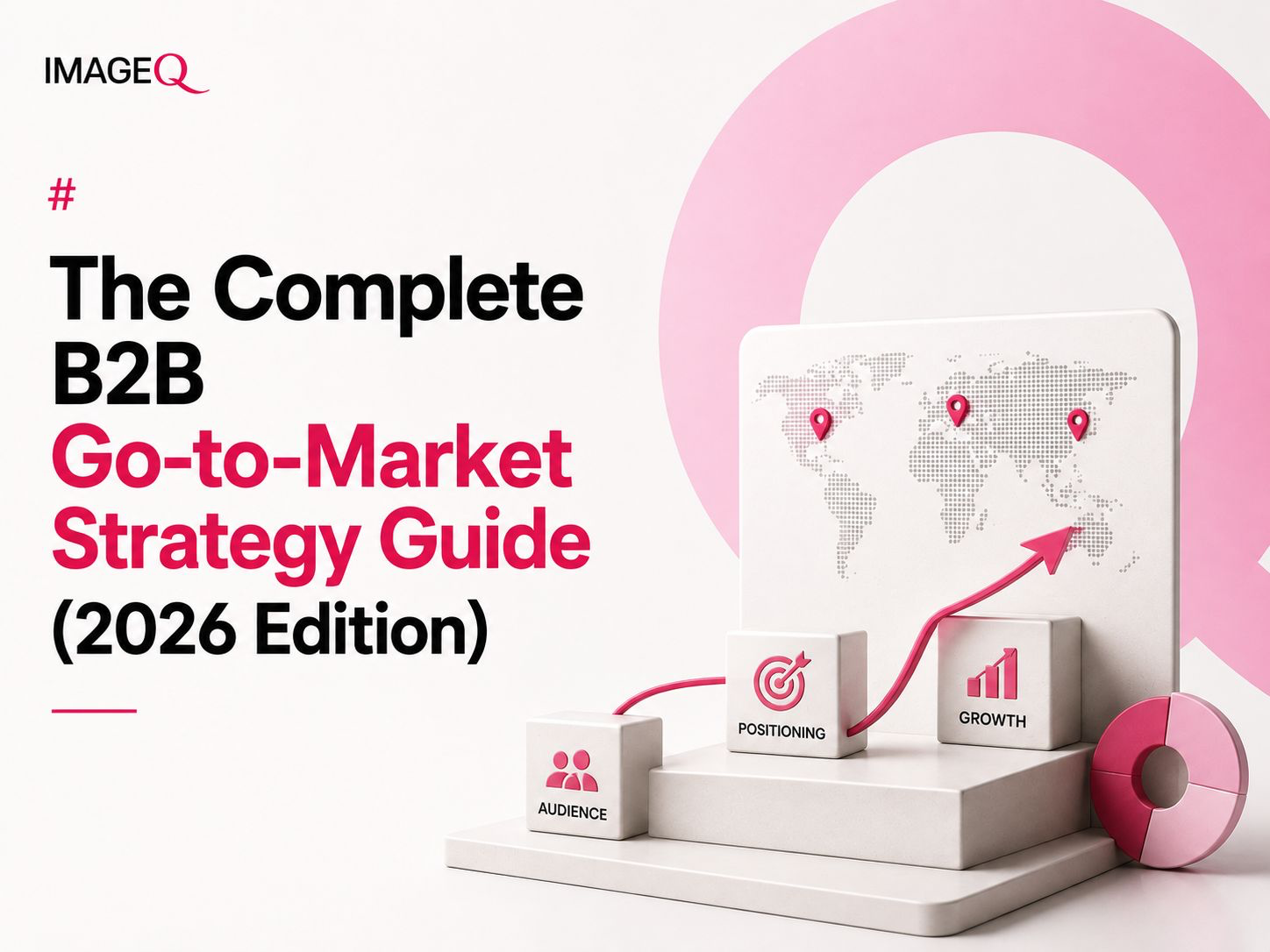
The Complete B2B Go-to-Market Strategy Guide (2026 Edition)
A great product doesn't guarantee business success.
Neither does a great website.
Or a larger sales team.
Or a bigger marketing budget.
Businesses don't grow because they execute more.
They grow because they execute the right strategy.
That's why every successful B2B company relies on a Go-to-Market (GTM) strategy.
A GTM strategy is the blueprint that connects your product, customers, positioning, sales, marketing, and operations into one unified growth system.
Without it, teams work hard—but often in different directions.
Marketing generates leads the sales team doesn't want.
Product teams build features customers never requested.
Leadership invests in channels that don't create meaningful growth.
A GTM strategy aligns every business function around one objective: delivering the right solution to the right customer through the right channels.
What Is a Go-to-Market Strategy?
A Go-to-Market strategy is a structured plan that defines how a business introduces, positions, delivers, and scales its products or services.
It answers critical questions such as:
- Who are we targeting?
- What problem are we solving?
- Why should customers choose us?
- Which channels should we use?
- How will we generate demand?
- How will we measure success?
When these questions are answered clearly, growth becomes intentional rather than reactive.
Step 1: Understand Your Market
Every successful GTM strategy begins with market intelligence.
Before investing in marketing or sales, understand the environment you're entering.
Research should include:
- Industry trends
- Market size
- Customer behaviour
- Competitive landscape
- Emerging opportunities
- Potential risks
Businesses that understand their market make better strategic decisions.
Businesses that rely on assumptions usually waste resources.
Step 2: Define Your Ideal Customer Profile (ICP)
One of the biggest mistakes businesses make is trying to sell to everyone.
A strong GTM strategy starts by narrowing focus.
Define your Ideal Customer Profile by asking:
- Which industries gain the most value?
- What company size fits best?
- Who makes buying decisions?
- What business challenges do they face?
- What outcomes are they trying to achieve?
The clearer your ICP, the more effective your marketing, sales, and messaging become.
Step 3: Build Strong Positioning
Customers don't buy products.
They buy confidence.
Your positioning should answer one question immediately:
Why should someone choose you instead of another provider?
Strong positioning defines:
- Your unique value proposition
- Your competitive advantage
- Your market category
- Your messaging
- Your brand narrative
Without positioning, marketing becomes expensive because every campaign has to explain who you are from the beginning.
Step 4: Create the Right Digital Foundation
Before launching campaigns, ensure your digital experience supports growth.
Your website should:
- Clearly explain your value.
- Build credibility.
- Answer customer questions.
- Guide visitors toward action.
- Support SEO and AI discoverability.
Your CRM, analytics, automation, and reporting should also be in place.
Marketing performs better when the destination is stronger than the campaign.
Step 5: Build Demand Before You Capture It
Many businesses jump directly into lead generation.
That's a mistake.
People rarely buy from businesses they've never heard of.
Demand generation creates familiarity before buying intent exists.
Effective demand generation includes:
- Thought leadership
- Educational blogs
- SEO
- LinkedIn content
- Founder branding
- Webinars
- Industry research
- Customer success stories
These activities create trust long before someone becomes a lead.
Step 6: Capture Demand Through Performance Marketing
Once awareness exists, performance marketing becomes significantly more effective.
Use channels such as:
- Google Ads
- LinkedIn Ads
- Meta Ads
- Email marketing
- Retargeting campaigns
- Sales outreach
Performance marketing captures existing demand.
Demand generation creates it.
The strongest GTM strategies invest in both.
Step 7: Align Sales and Marketing
One of the biggest causes of slow growth is misalignment.
Marketing celebrates lead volume.
Sales complains about lead quality.
Customers receive inconsistent messaging.
Successful businesses ensure sales and marketing share:
- One Ideal Customer Profile
- One positioning statement
- Shared KPIs
- Consistent messaging
- A unified customer journey
Alignment improves conversion rates and reduces wasted effort.
Step 8: Measure What Matters
Many businesses focus on vanity metrics.
Impressions.
Clicks.
Followers.
Traffic.
These are useful indicators, but they don't define success.
A stronger GTM dashboard measures:
- Pipeline growth
- Qualified opportunities
- Customer acquisition cost (CAC)
- Customer lifetime value (LTV)
- Conversion rates
- Sales cycle length
- Revenue growth
- Customer retention
Business outcomes matter more than marketing activity.
Common GTM Mistakes
Even experienced businesses fall into familiar traps.
Launching before validating market demand.
Targeting too many customer segments.
Weak positioning.
Poor website experience.
Sales and marketing operating independently.
Relying entirely on paid advertising.
Ignoring customer feedback.
Treating GTM as a one-time exercise instead of an evolving strategy.
Avoiding these mistakes often creates a greater competitive advantage than simply increasing marketing spend.
The ImageQ GTM Framework
At ImageQ, we approach Go-to-Market strategy as a connected growth system.
Understand
Research the market, customers, and competitors.
↓
Position
Define your value proposition, messaging, and competitive advantage.
↓
Build
Create the digital infrastructure that supports discovery, trust, and conversion.
↓
Generate
Build awareness through thought leadership, SEO, and demand generation.
↓
Capture
Use performance marketing and sales enablement to convert demand into customers.
↓
Optimise
Measure performance, refine strategy, automate operations, and continuously improve.
Every stage strengthens the next.
Growth becomes predictable because every business function works together.
Final Thoughts
A successful Go-to-Market strategy isn't a launch checklist.
It's the operating system behind sustainable business growth.
When market intelligence, positioning, digital experience, demand generation, sales, and measurement work together, businesses stop relying on isolated campaigns and begin building scalable growth engines.
At ImageQ, we believe the strongest businesses don't simply execute faster.
They execute with greater clarity.
Because the companies that win aren't always the ones with the biggest budgets.
They're the ones with the clearest strategy.
ImageQ is a creative digital marketing agency helping ambitious startups and growth-stage companies build scalable go-to-market systems through strategy, positioning, authority-building, content ecosystems, demand generation, automation, and conversion optimization.